Tag-arkiv: artistic research

Visiting Artistic Fellow at the Fiber Department at Cranbrook Academy of Art

So much has happened during my 5 weeks as visiting artist the Fiber Department at Cranbrook Academy of Art — I met inspiring artists, researchers, and students, and encountered the diverse, complex textures of Detroit. This journey has been both artistically and personally transformative.

☘️☘️ Takeaways ☘️☘️
This residency reminded me of the power of artistic exchange — how dialogue, material exploration, and shared curiosity open new ways of thinking and making. I leave Detroit with a renewed sense of how textiles connect bodies, stories, and communities — and with threads of inspiration that will continue to weave through my practice.


I send my gratitude to the Fiber Department:

Thank you Joey Quiñones –incredible artist-in-residence and head of Fiber– for welcoming me so openly into the department.
To all the students — Tracy Ren, Irene Perez, Ivan Flores, Emily Dormier, Maddie Gordon, Julia LeKander, James Baxter, Ashley Rossi, Brianna Markley, Emily Hunt, Nick Cox, Diane Yu, Ruth Xu Huang and Star Seven — thank you for letting me join your CRITs and for sharing your textile worlds. You have all left a deep impression on me ☘️

I’m deeply grateful to Statens Kunstfond for generously supporting this artistic journey, and to Anders Ruhwald for organizing the residency at Dubois Street and the fellowship at Cranbrook Academy of Art. Last but not least Jose Arenivar-Gomez – director of 3583 Dubois St. and an extraordinary ceramic artist – thank you for being such a generous and caring host — for sharing your space, knowledge, and hospitality.


📷 Encountering the architectural beauty of Cranbrook Academy of Art with Elan Schwarts. Photo by Midge W

Sharing artistic research practice across borders

On my USA travels, I have so far had the privilege of engaging with students and colleagues in both artistic and academic contexts.

At Vanderbilt University, Nashville, Christin Essin kindly arranged a wonderful program of professional and social encounters. I had the pleasure of attending several of her storytelling classes, and she also organized a lecture for students and staff, where I unfolded my research on textile listening(s) — for example, how materials, bodies, and collective practices can generate new ways of sensing and knowing together. As part of the lecture, I introduced a few hands-on exercises. In addition, Alexandra Sargent Capps generously invited me to give a co-sampling workshop in her fashion studio-class.


At the School of the Art Institute of ChicagoCamille Martin-Thomsen, kindly introduced me to her colleagues. Abigail Glaum-Lathbury, at the Fashion Department, arranged a talk for students and faculty from the fiber, fashion, and fiber art departments, where I unfolded my artistic practice. Afterwards, I facilitated a short practice-based workshop, connecting my research with hands-on explorations of textile-relational listening spaces.

I am deeply grateful for the inspiring conversations and the opportunity to share and exchange across disciplines and geographies. Encounters like these are vital — they not only disseminate research, but also expand artistic practice through collective dialogue and experimentation.

I am grateful to Anders Ruhwald and Statens Kunstfond that made this trip possible with a generous grant.

BECOMINGS

BECOMINGS is a textile-relational, participatory artwork in which hands engage in acts of crafting, materials carry embedded stories, and dialogues emerge through shared gestures. The work invites participants into a space of co-crafting, where textile and relation become inseparable.

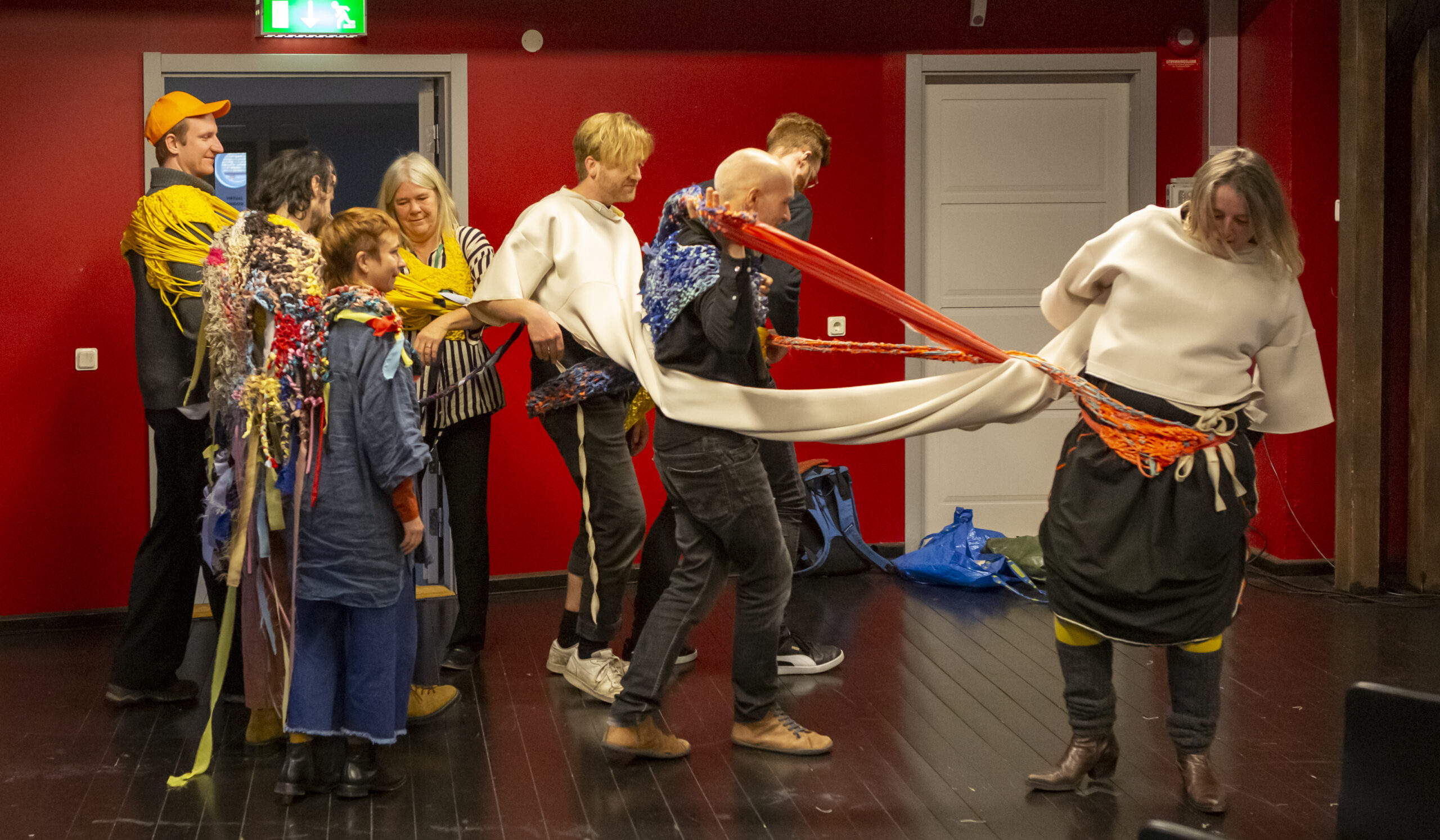
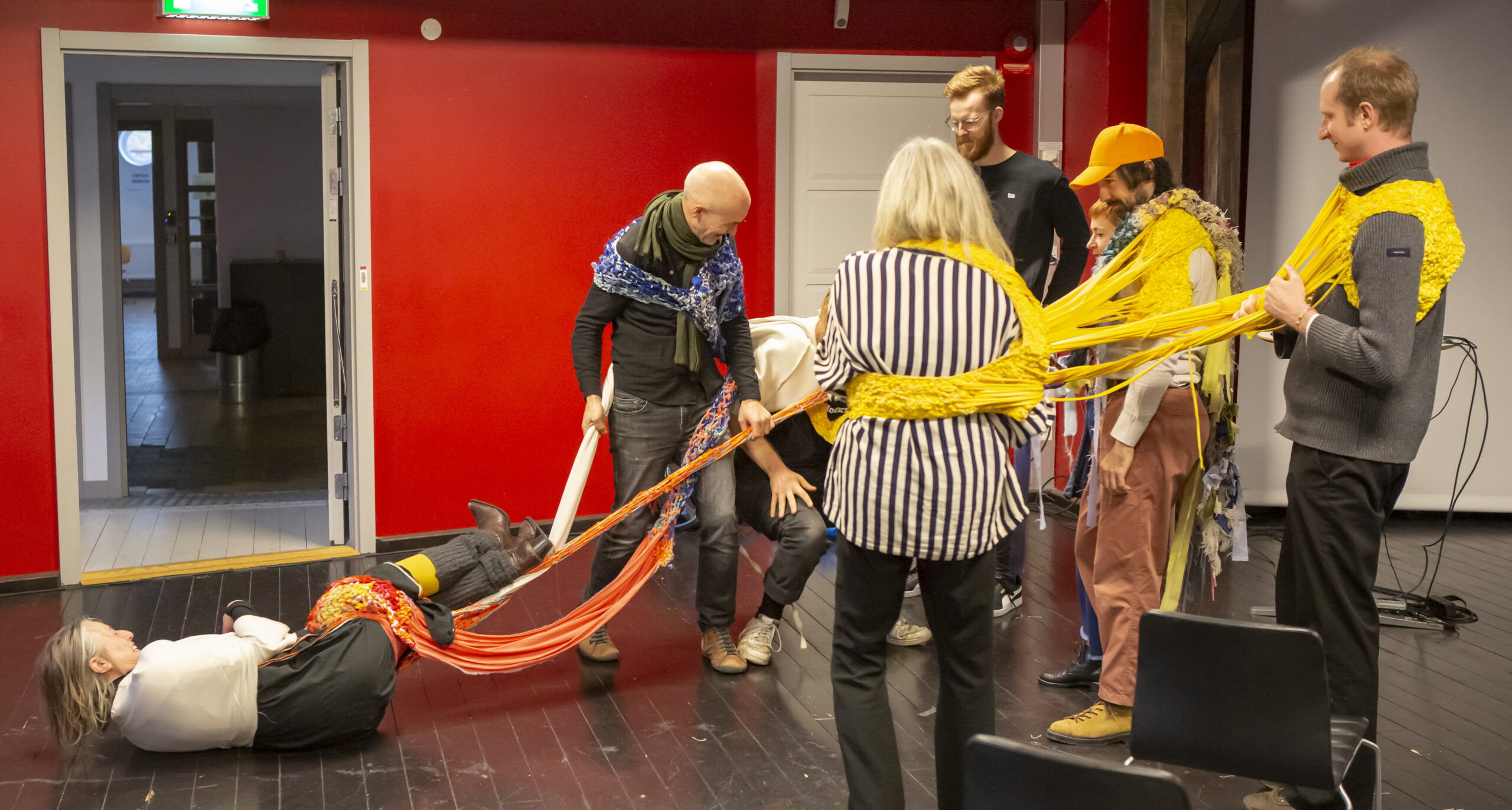
With the support of The Danish Art Foundation, BECOMINGS was presented as a durational, seven-hour participatory performance at Riga Performance Festival STARPTELPA. The audience was invited to enter the artwork itself—to engage in co-crafting and transformation. Through these collective actions, movements were set in motion: within the materials, within the participants, and within the artwork as a living entity. Small gestures—such as tying a knot—demonstrated the potential of tactile encounters to cultivate textile-relational communities.

Through BECOMINGS, I gather and trace textile-relational stories embedded in the materials. As the textiles cannot speak for themselves, I assume the role of host—sharing their histories, transitions, and transformations. For example, the textiles used in this work formerly appeared as costumes in Forum Humanum (2013), a performance by X-Act/Kitt Johnson. Traces of that performance remain inscribed in the textiles, carrying their performative past into new contexts.

Moreover, the artwork has been shaped by many hands. Those who have participated in its making and crafting leave behind material traces—physical and ephemeral—that remain visible and integral to the evolving form of the artwork. By tracing these narratives, I seek to acknowledge and honour the lands and hands that have made the fibres’ journey possible. This is both a gesture of gratitude and a recognition of the interconnected processes—ecological, social, and artistic—that enable BECOMINGS to continually unfold through participation and relational care.

Keynote: Material Listenings – Traveling in the Borderlands of Costume, Exploring Collective Bodies

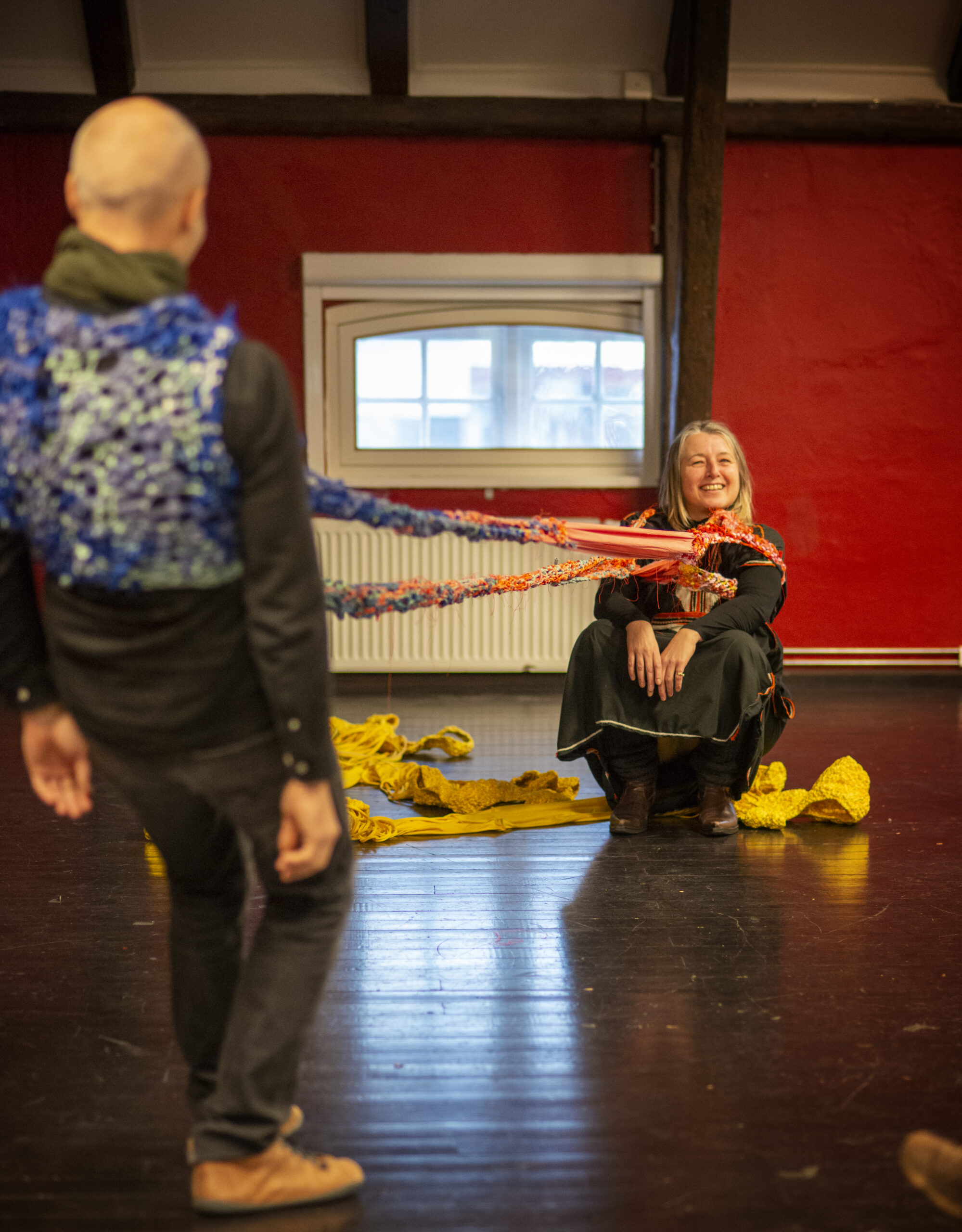
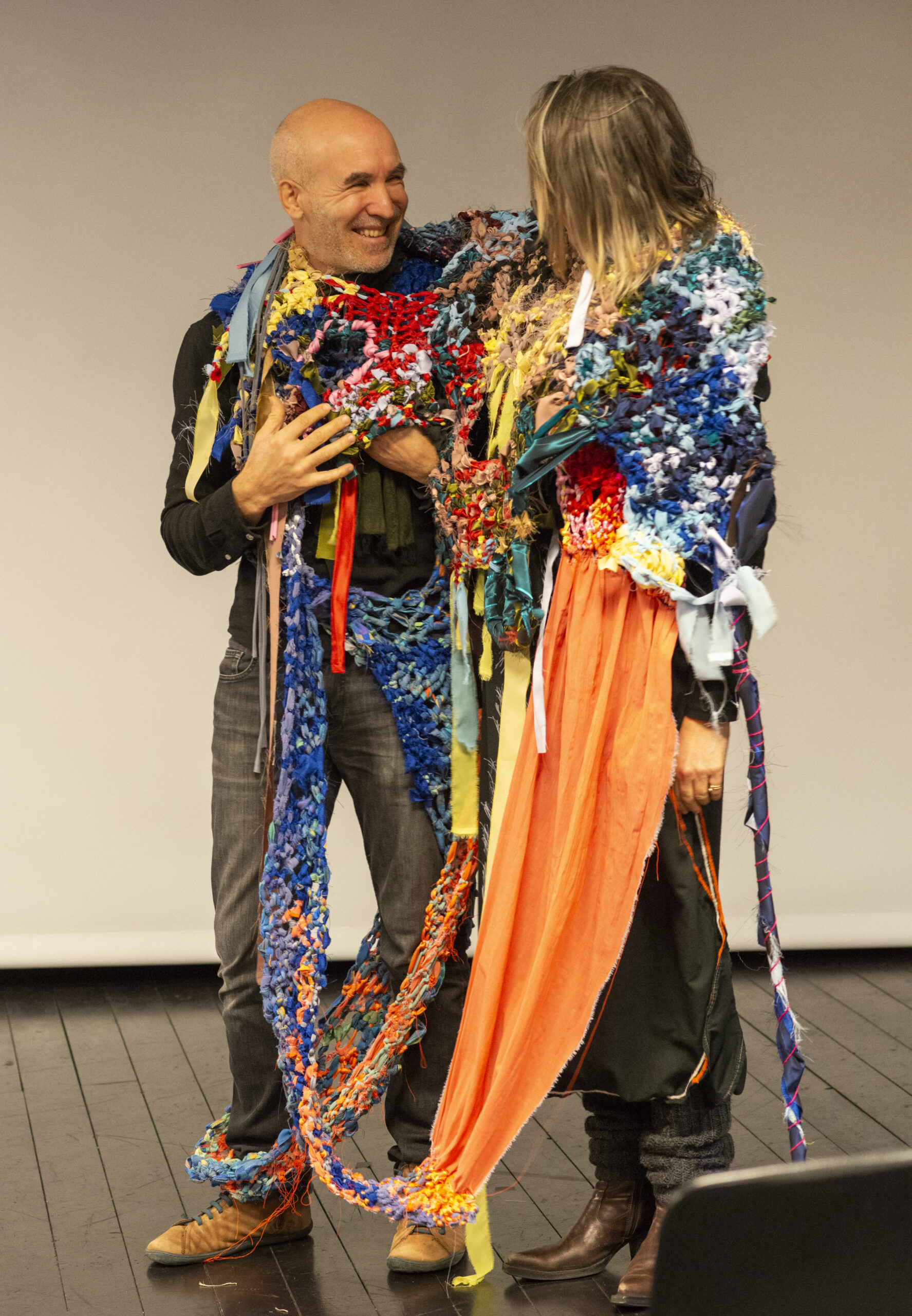
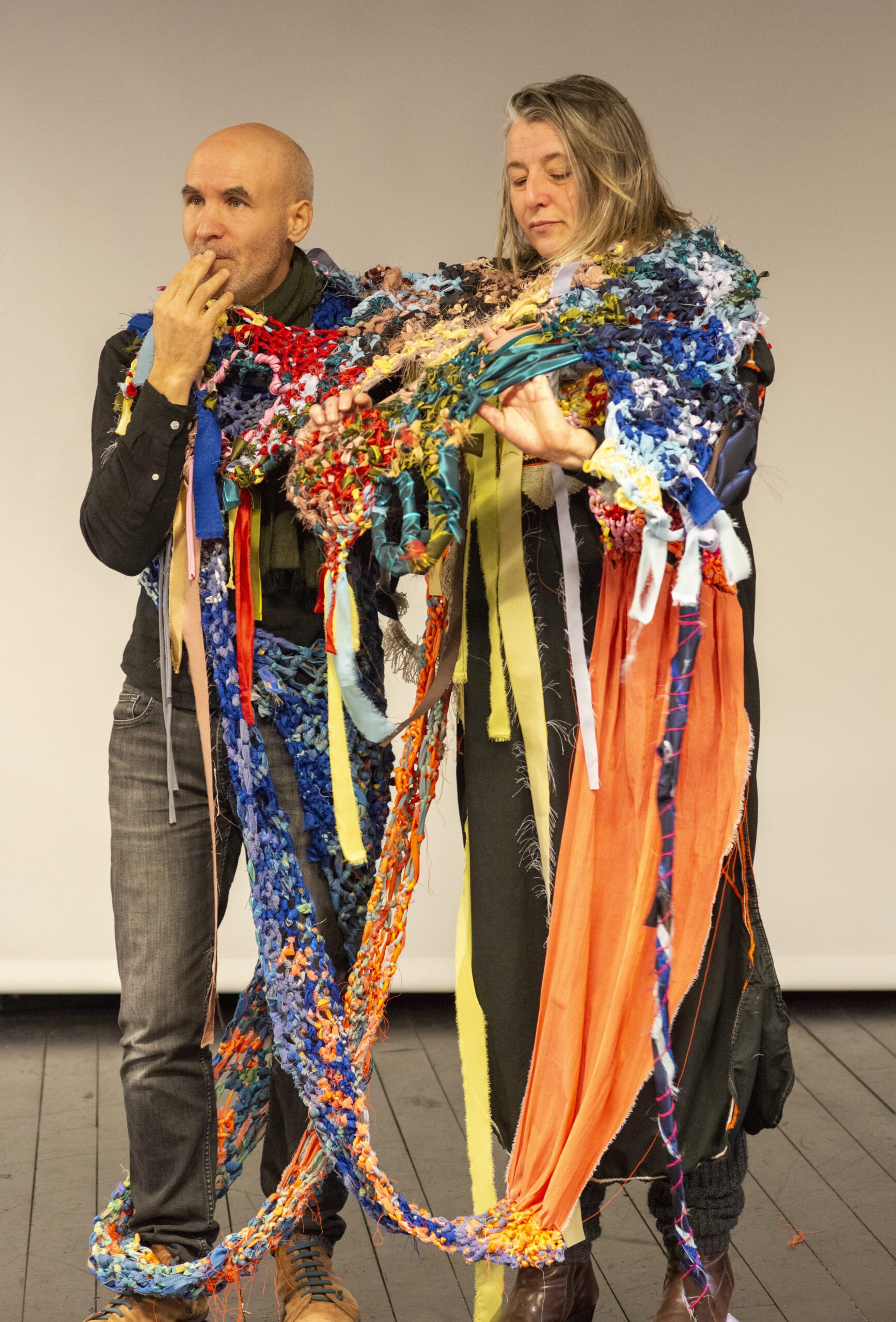
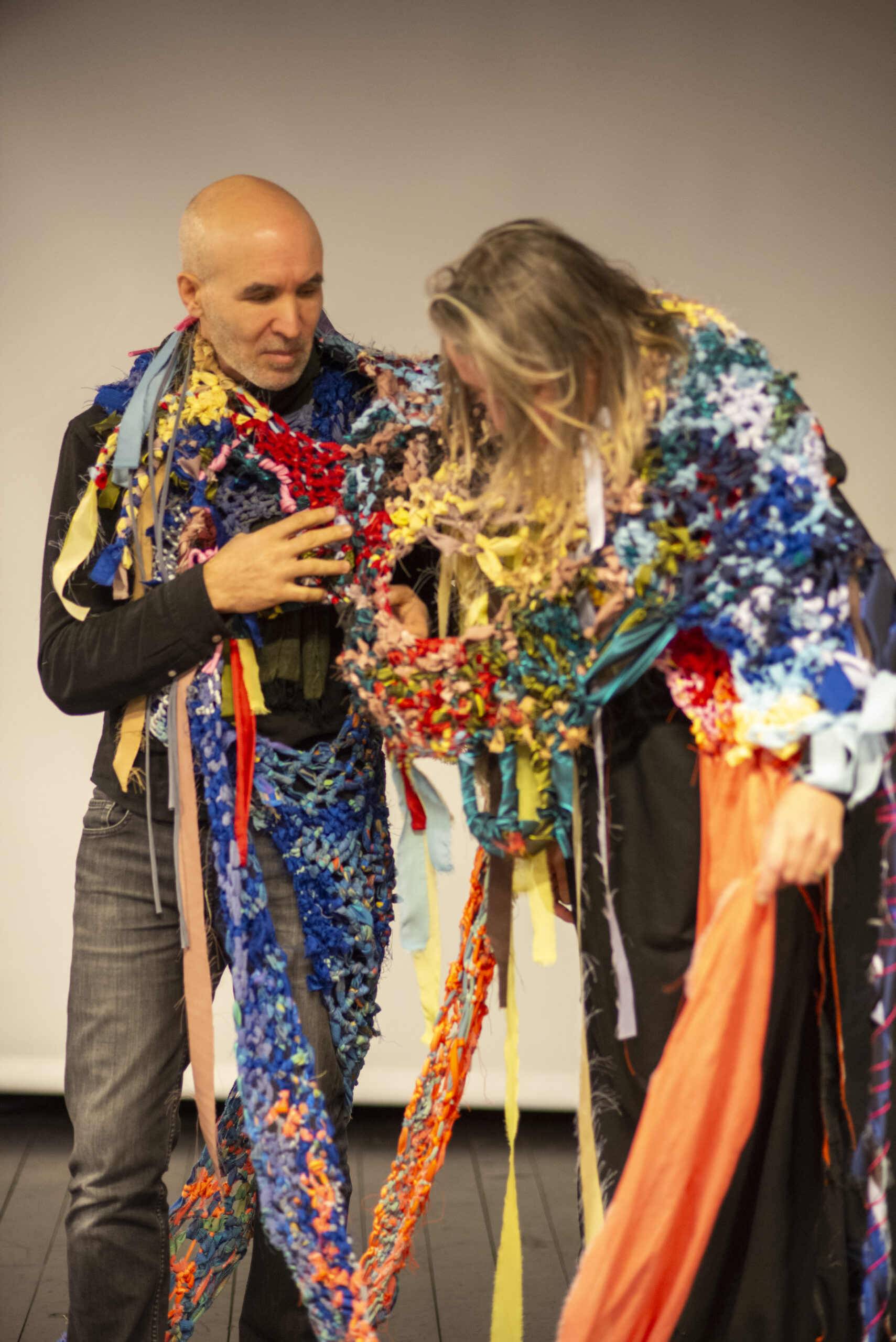
In my keynote Material Listenings – Traveling in the Borderlands of Costume, Exploring Collective Bodies at the Riga Performance Festival Starptelpa conference Embodied Visions: Performativity, Visuality, Materiality (1960s–1980s), I unfolded aspects of the artistic practices of Lygia Clark, Maria Blaisse, and Pauline Oliveros, and shared insights from my ongoing artistic research project Community Walk—a participatory, textile-relational practice that explores how human and nonhuman bodies co-compose fragile, collective constellations. Each iteration of Community Walk invites participants to co-wear a costume and walk together, attuning to one another with a heightened sense of with-ness. Through these shared movements, the work cultivates a polyphonic kind of listening—attentive to difference, risk, tenderness, and transformation. The walks are not choreographed in advance but emerge through soft hosting, relational responsiveness, and a willingness to dwell in the unpredictable.

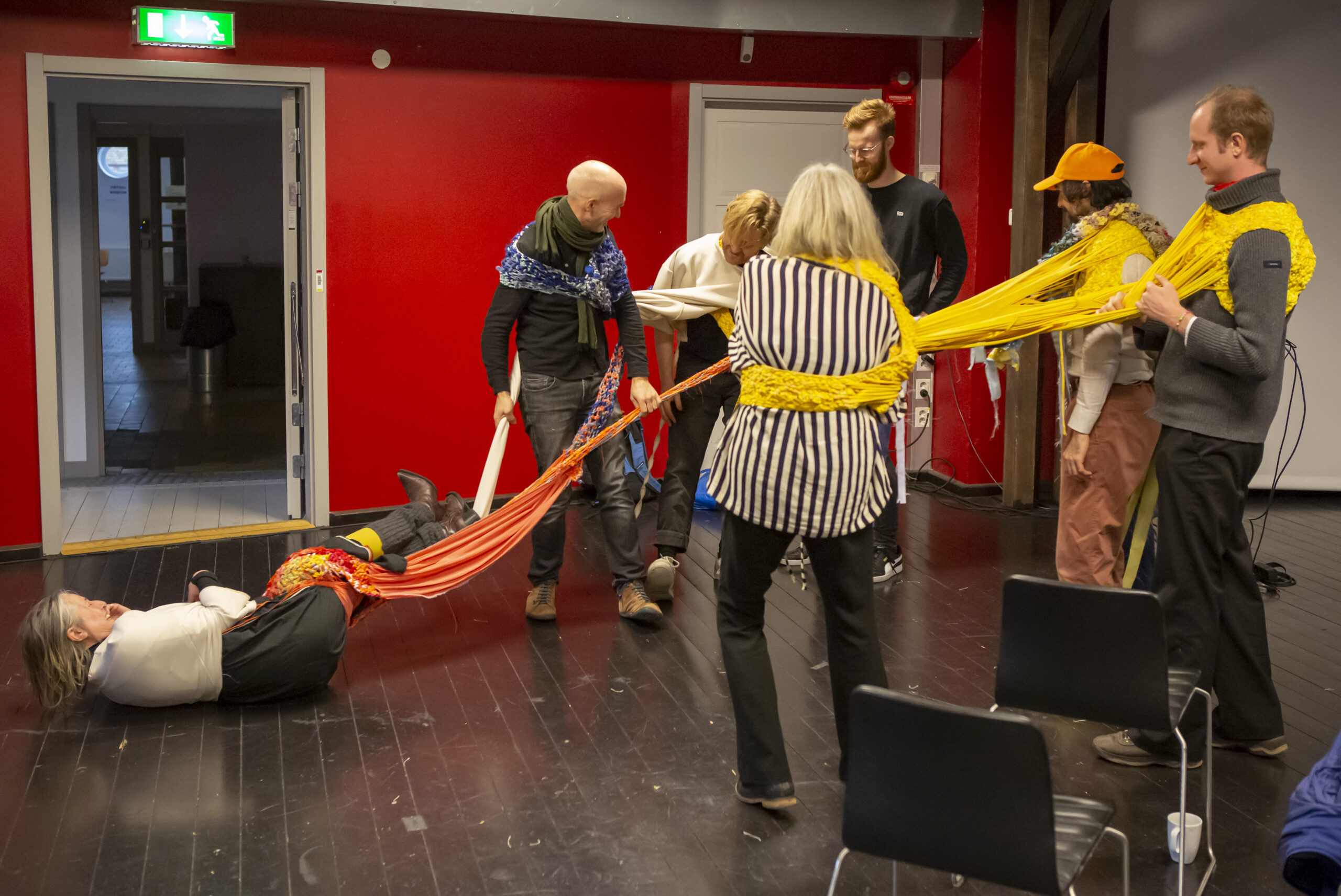
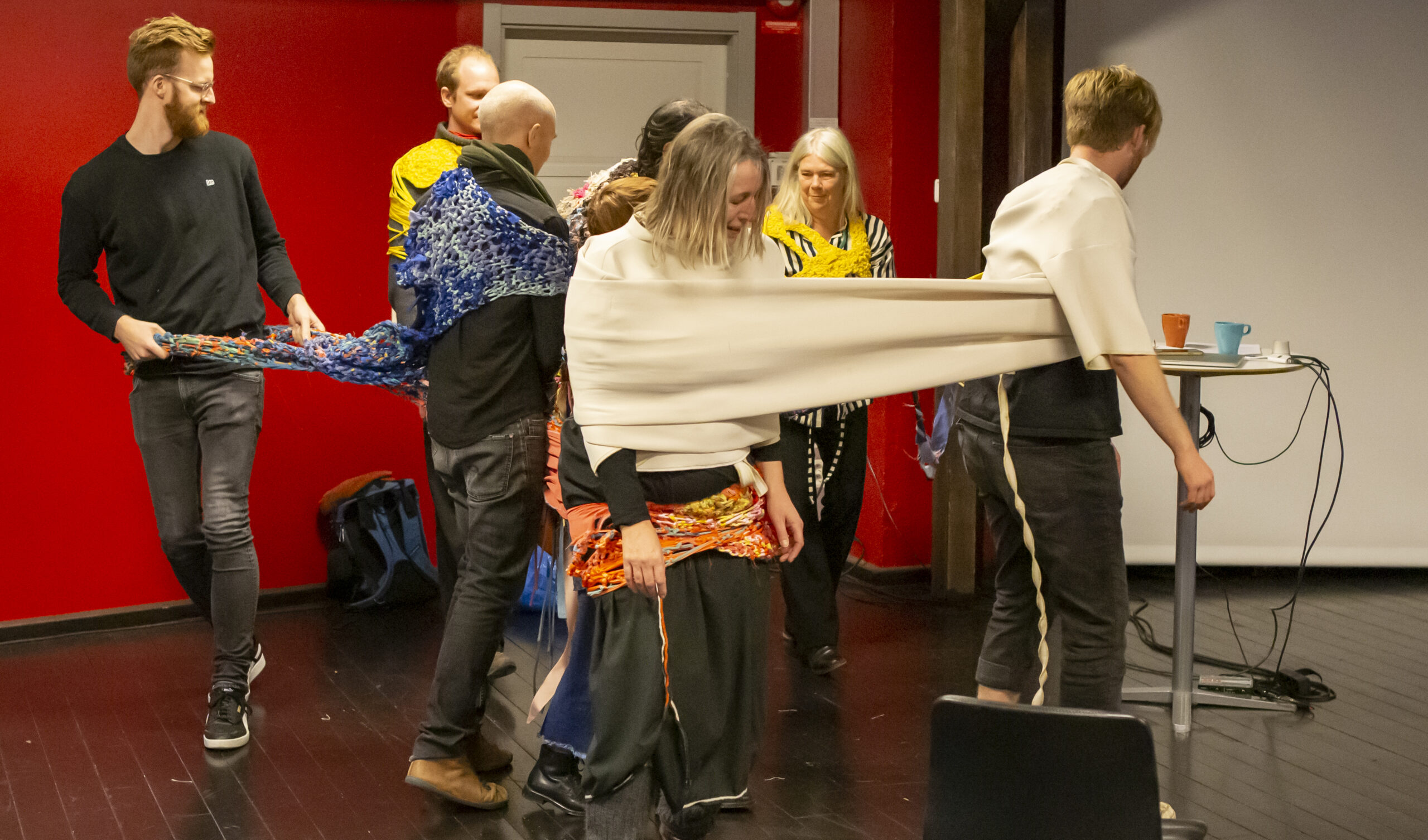
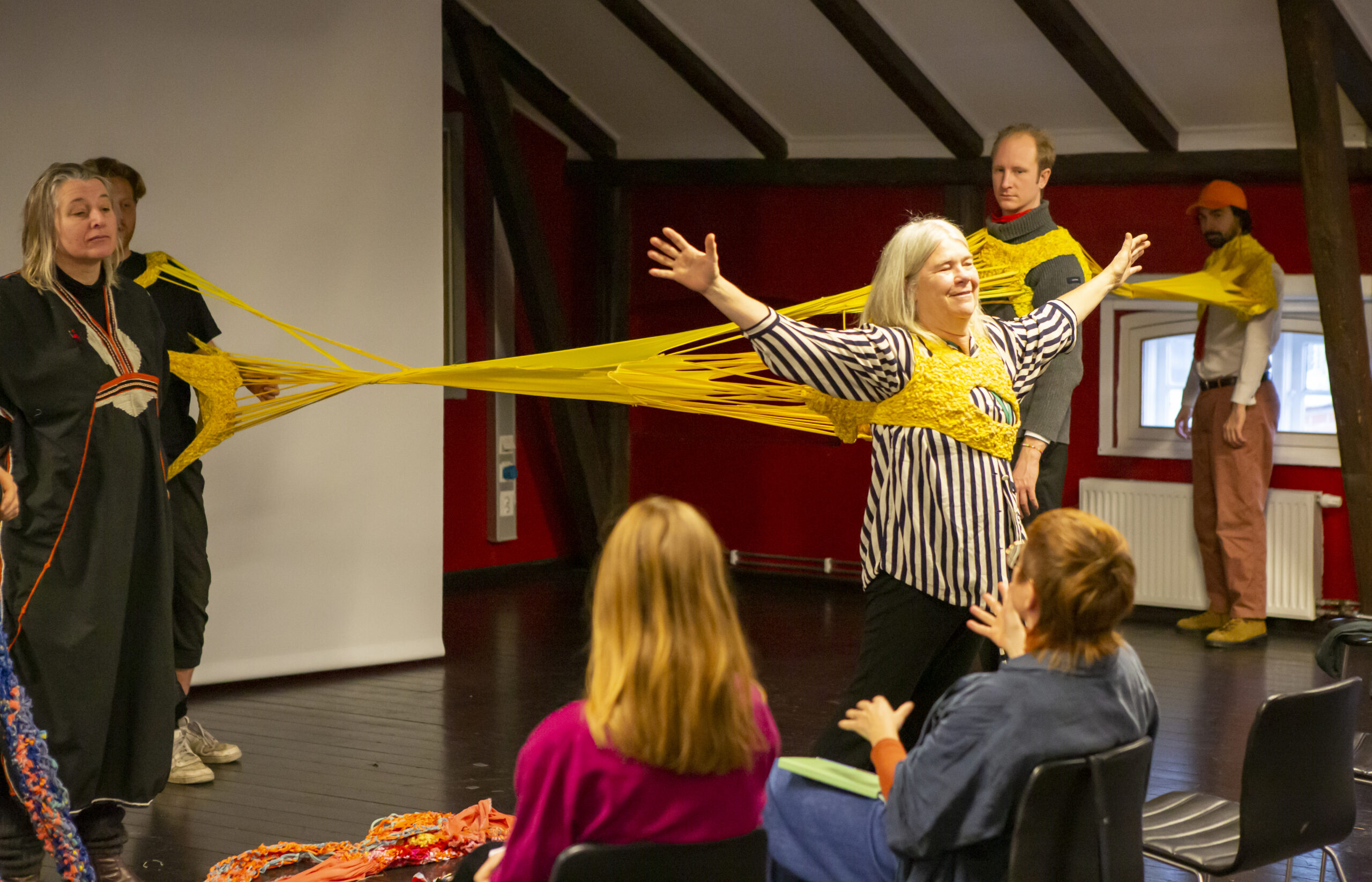
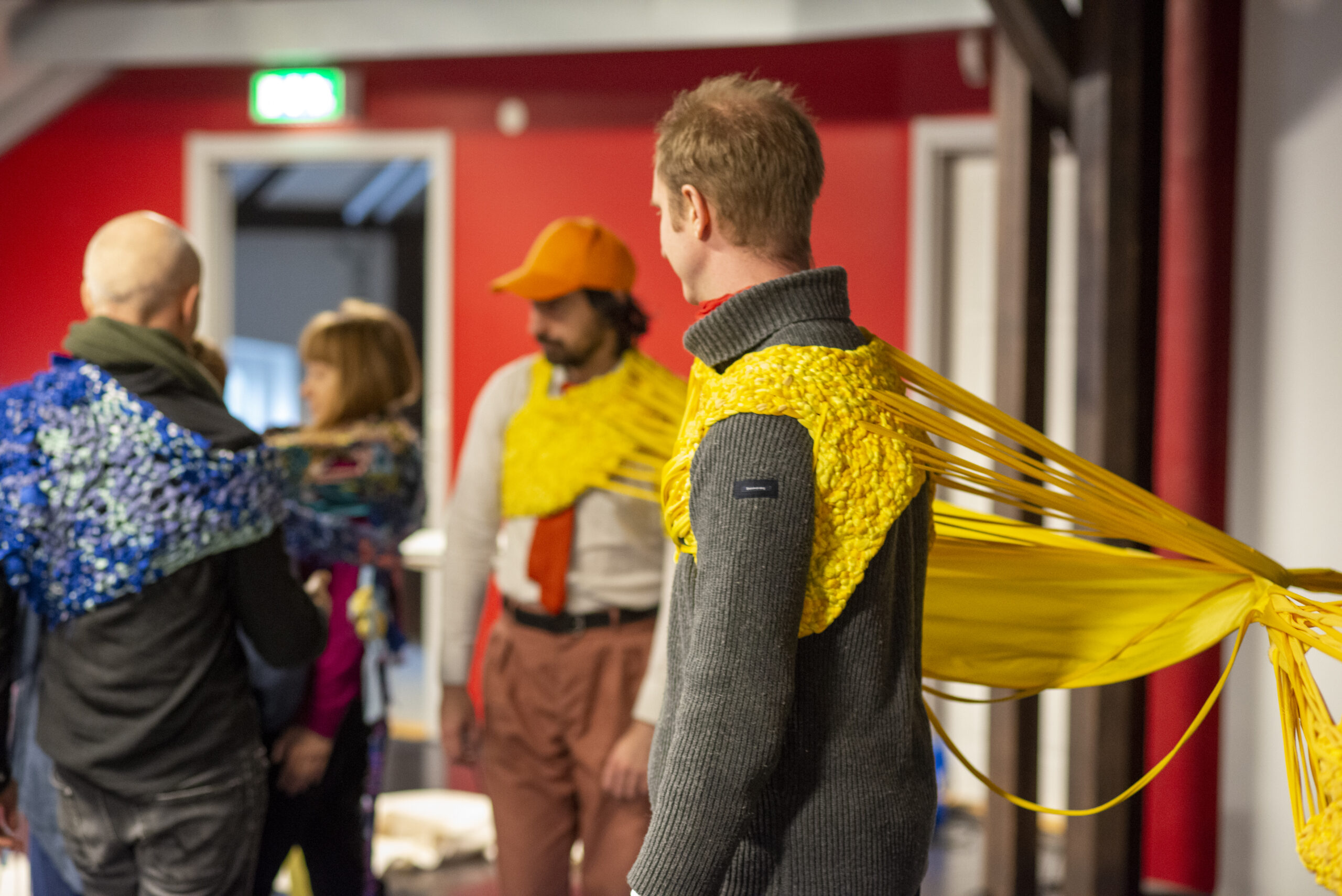
As part of the keynote, I invited the audience into an artistic intermezzo: a moment of embodied participation in which we co-wore a hand-crocheted textile network. In this shared gesture, we temporarily enacted the fragile and interdependent nature of collective becoming—dwelling together in the porous space between independence and mutual care.

I am grateful to Laine Kristberga for the kind invitation to share my research in this context.

I like to acknowledge Metropolis that hosted the first version of Community Walk (2020) and have invited the participatory version of Community Walk to be part the Performing Landscapes (2025) program.

Phd defence

On January 15, 2025 at Bryggeriteatern, Malmö Theatre Academy, Lund University, Sweden I had my doctoral defence. At the defence I had made an exhibition in the theatre space with the connecting costume and the knotted textiles that I had made during the research periode.

Photo: Sergio Gianoli

I wanted my textile companions to surround me – to be present as they speak for themselves – as well as that I wanted the audience to enter my textile world.

As part of my defence I had invited the dancers Alex Berg, Camille Marchadour, Daniel Jeremiah Persson and Josefine Ibsen to perform an improvised version of AweAre – a movement quintet.

Opponent: Dr. Donatella Barbieri, University of the Arts London.   
Chair (Ordförande): professor Sven Bjernstedt, Teaterhögskolan i Malmö.   
Committee (Betygsnämnd): professor Henrik Frisk, dr Anne Louise Bang, dr Rachel Hann and dr Madeline Taylor.    

As written on Lund University’s webpage I am the first person to recieve a doctor degree within the subject of costume. Read more here

Main supervisor: Dr Sofia Pantouvaki – scenographer and Professor of Costume Design at Aalto University, Finland.    
Second supervisor: Dr Camilla Eeg-Tverbakk – dramaturgue and Professor at Oslo Metropolitan University, Norway.

Entanglements

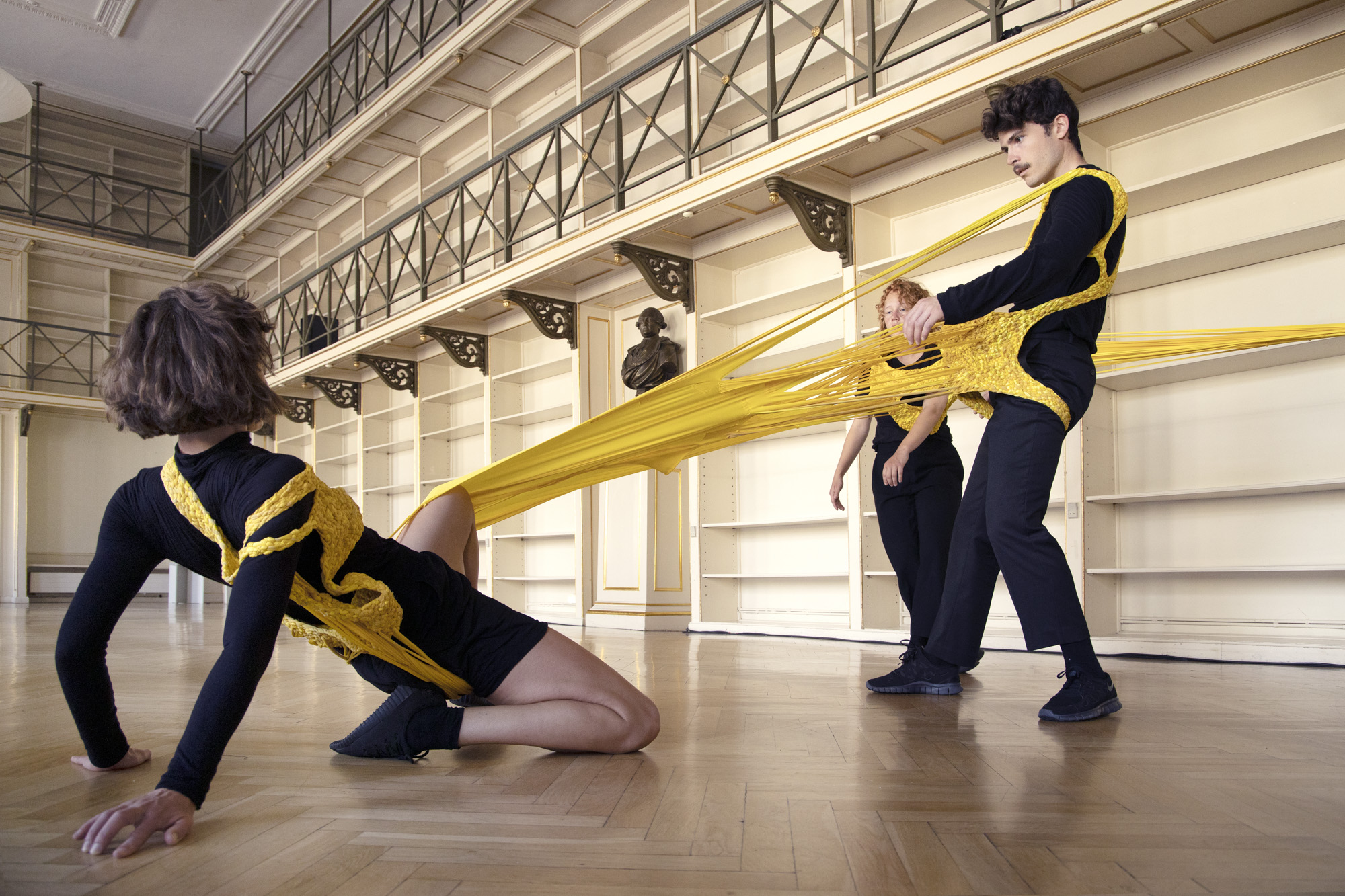
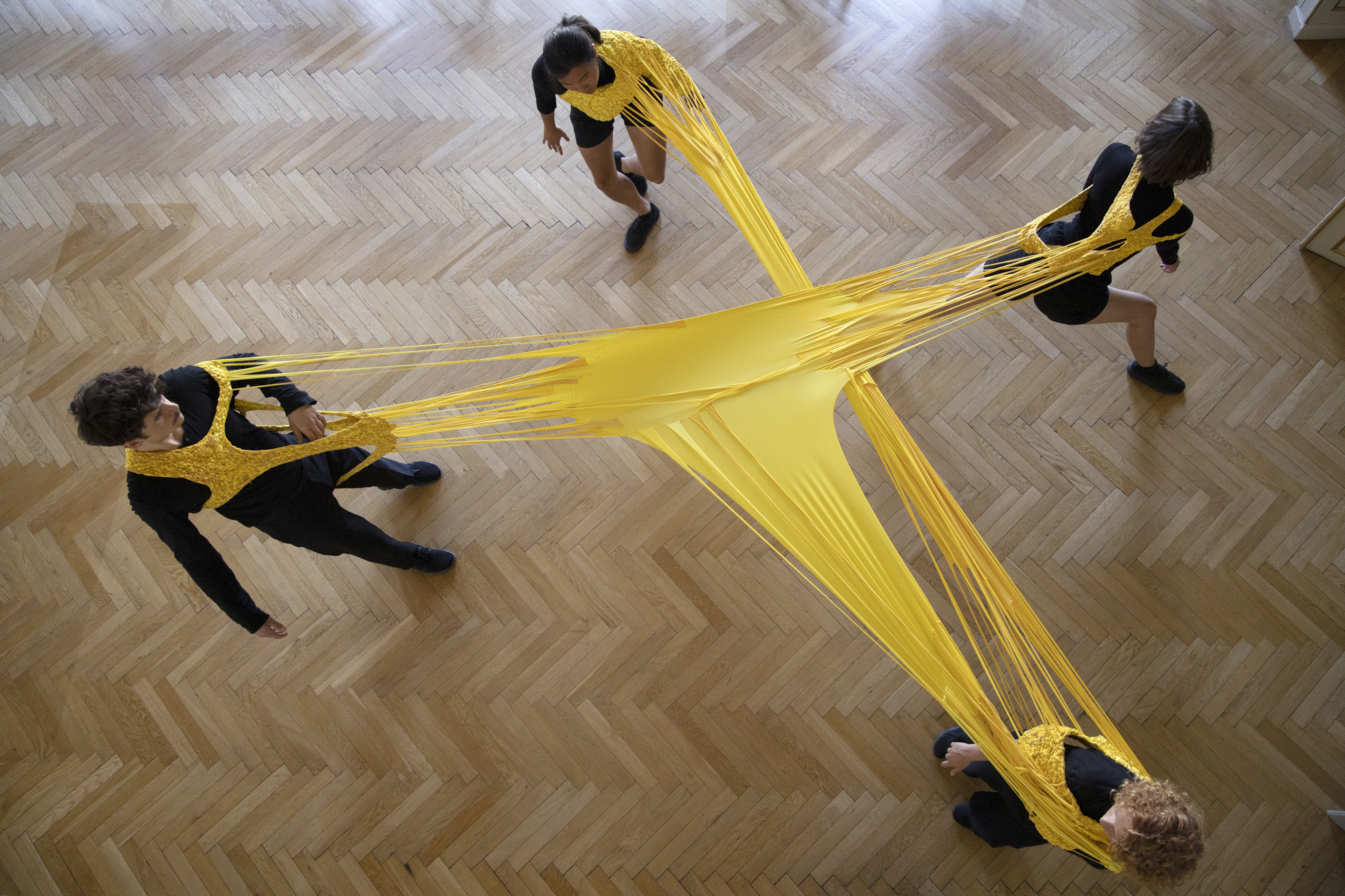
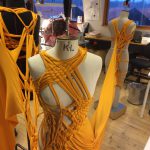
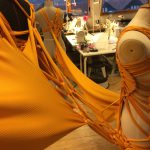
Entanglements is an artwork that I, as artist, suggest is placed in the borderland between textile object, spatial entity, and wearable art. I suggest that the artwork is an object with a performative human and more-than human material-spatial potential. Entanglements are exhibited at MATERIAL THINKING – 1st International Contemporary Material Art Biennale, Tsinghua University, China (02.12.2022–27.01.2023)
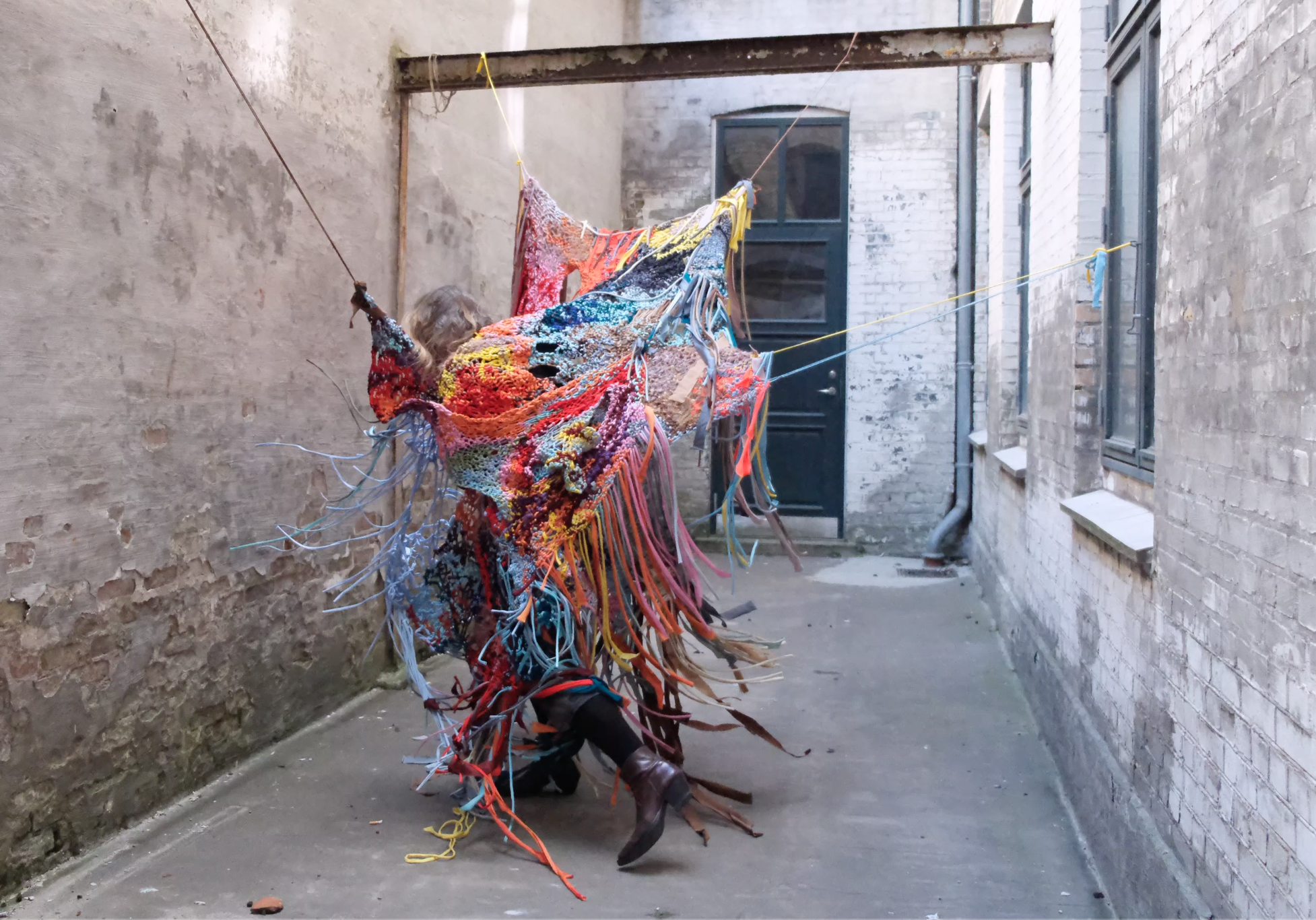


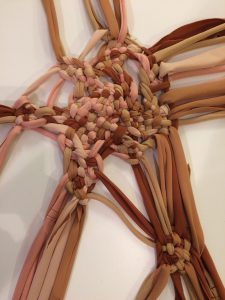
This artwork Entanglements build on Donna Haraway’s notion of ‘making kin’ and Jane Bennett’s concept of vibrant matter. ‘Making kin’ suggests that I, the artist, create a relationship to and with the materialities that I craft. When I craft a dynamic tension occurs between me and the vibrant materialities. Through crafting I must listen to and follow the complexity of the materialities. Therefore, I must be sensitive and openminded towards the materialites’ ‘voices’ and ‘wills’. I must listen to how the materialities including their colors wants to be combined and composed. When I craft, I drift and dwell with the materialites. I led them guide me and while crafting Entanglements I came in a mediative state. 

At some point in the process and without realizing, my crafting had become quite specific. It was like that I, in my meditative state, began to control the materialities. It was like I forgot our vibrant relationship. I had to stop and re-create the dynamic tension between me and the materialities. I needed help and therefor I decided to invite colleagues like designers, dancers, and choreographers to join me to co-compose and co-embody the composition in multiple ways. In different sessions and with different colleagues, I and we explored other ways of ‘making kin’. We co-explored human-material-relationships, human-material-movements, and material-compositional-potentialities. Our embodied explorations expanded the meaning of ‘making kin’ and awoke my sensibility towards the materialities in unexpected ways. Co-crafting, co-embodying, and co-moving with the crafted materialities became ways of ’making kin’ – actions that left traces of human interaction.  Traces of human bodies that have affected, informed, re-formed, composed and re-composed Entanglements.  And now dear audience you meet Entanglements and I invite you to leave your traces – and I when I meet Entanglements again, I hope that there are new traces of other bodies. 
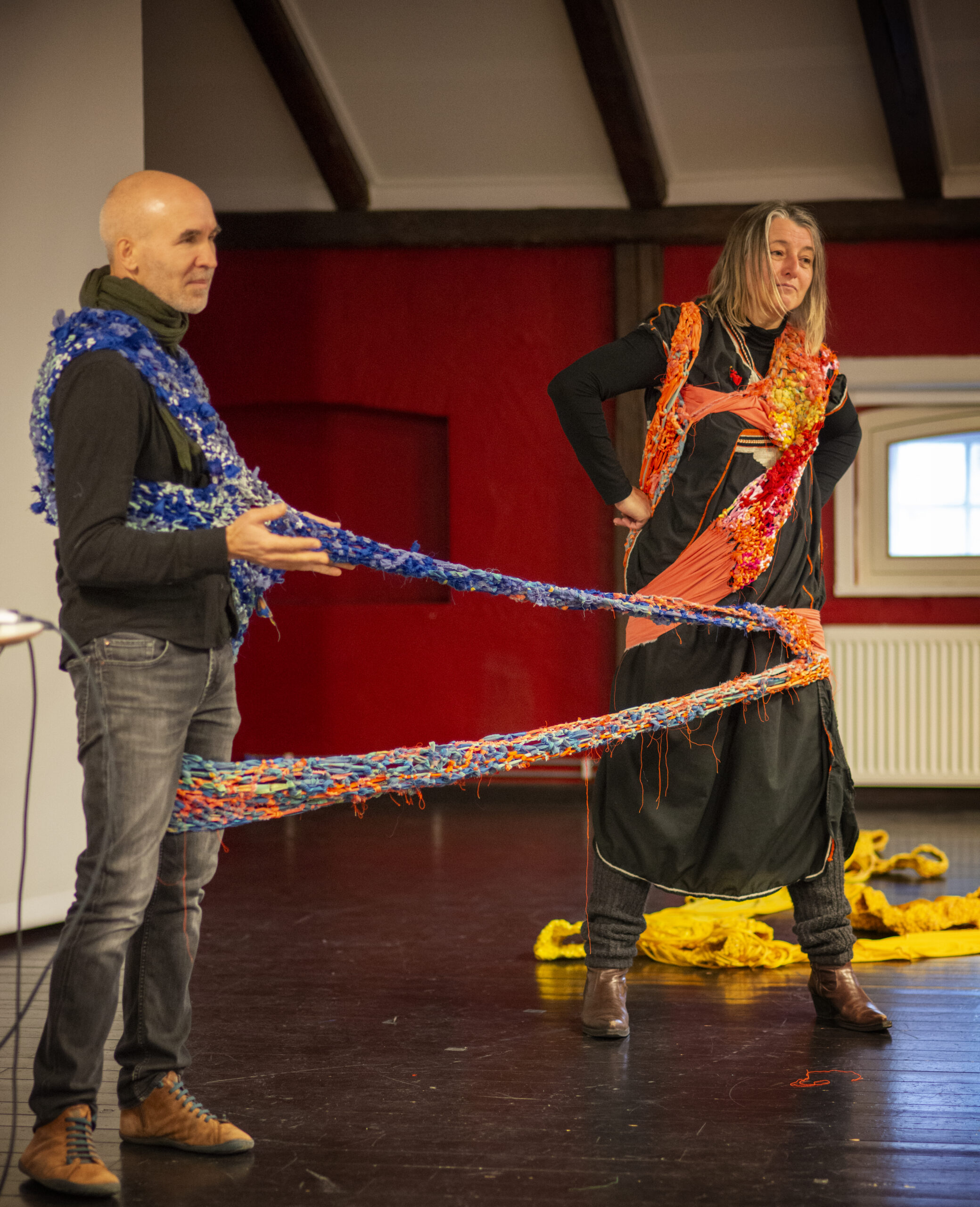

“inside out – outside in”

At the immersive days in november 2022 composer Yann Coppier and I in our presentation “inside out – outside in” reflected on how world-costume and sound can co-create immersive experiences. One of our questions are how does Yann compose textile and how Charlotte designs sound – or – how does sound inform textile and how does textile inform sound?
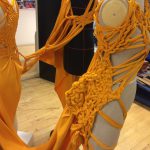
In the presentation we immersed ourselves in word-costume or entalgled through spatial textiled-costume.

During the talk the audience engaged and tangled with us – which became playful embodied explorations.
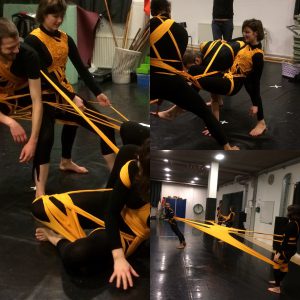
Critical Costume 2022

I am so please to be selected to participate with the paper “Ethical Dilemmas of listening through and with costume” and the video “Costume connections” at Critical Costume 2022.

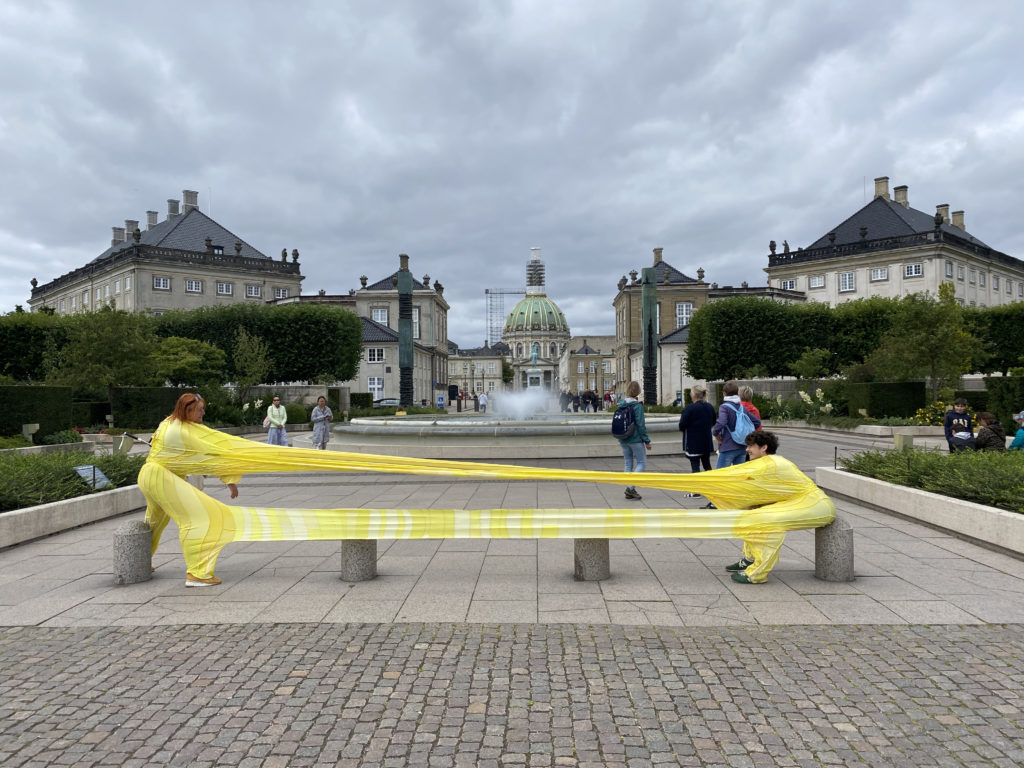
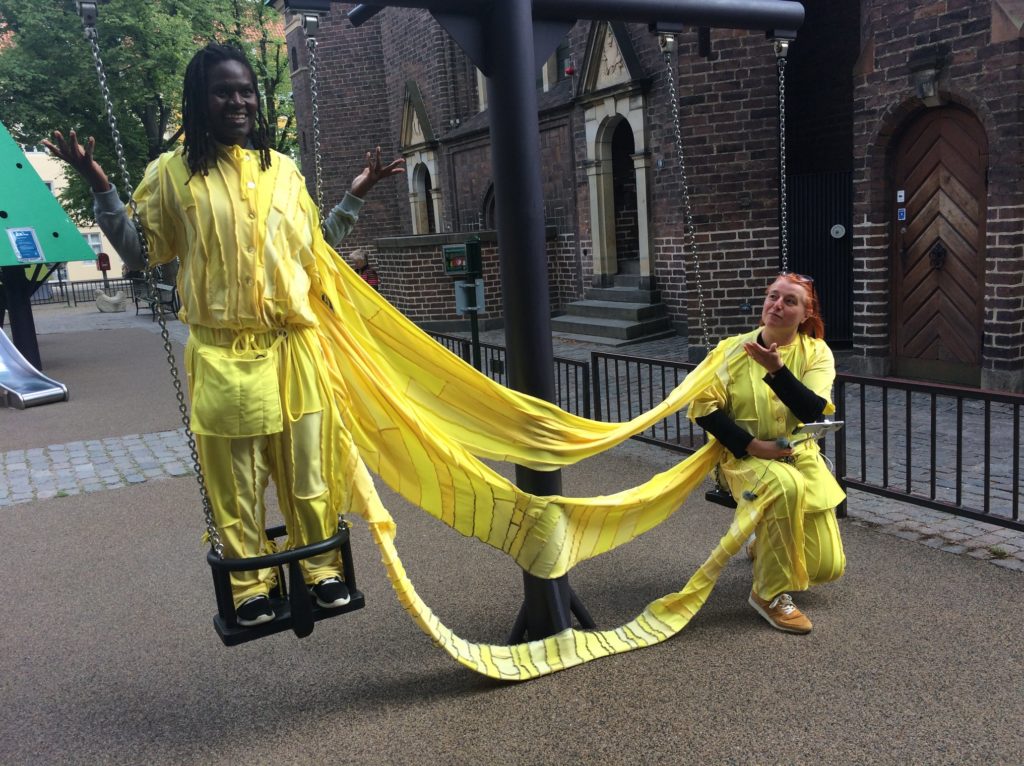
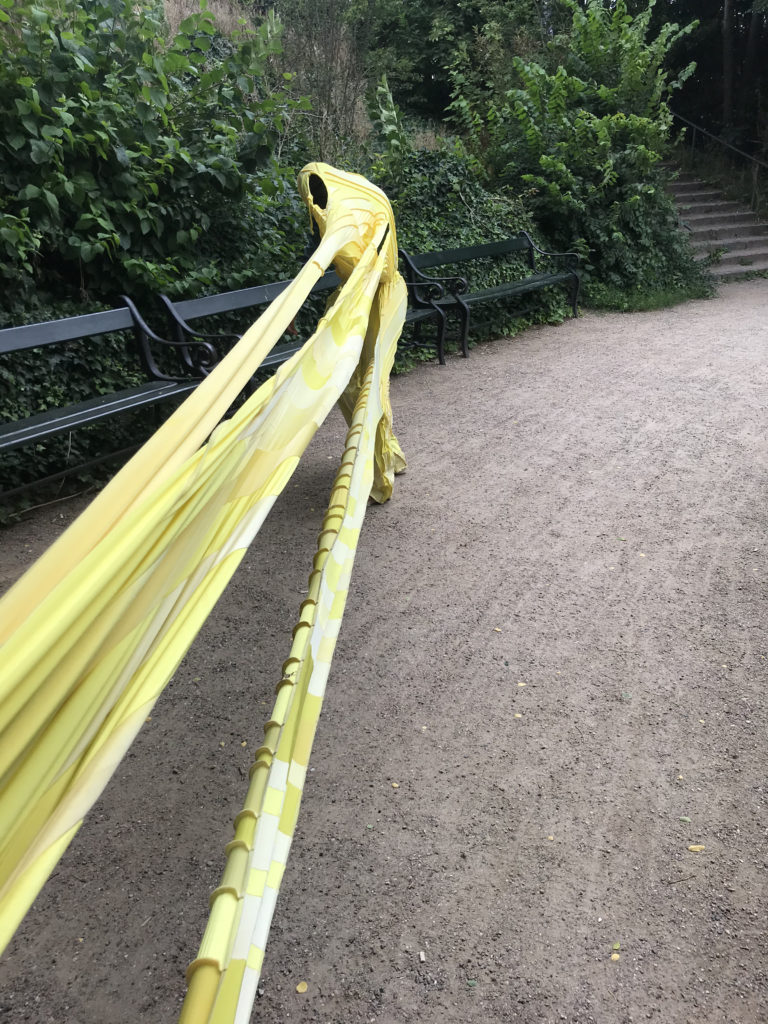
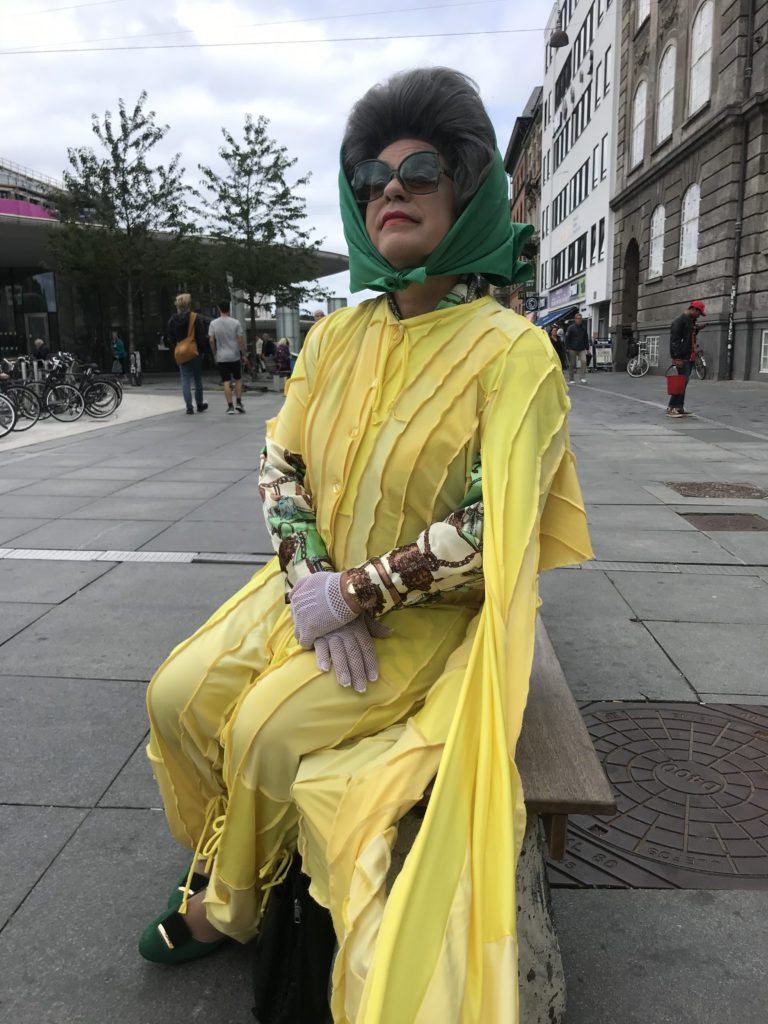
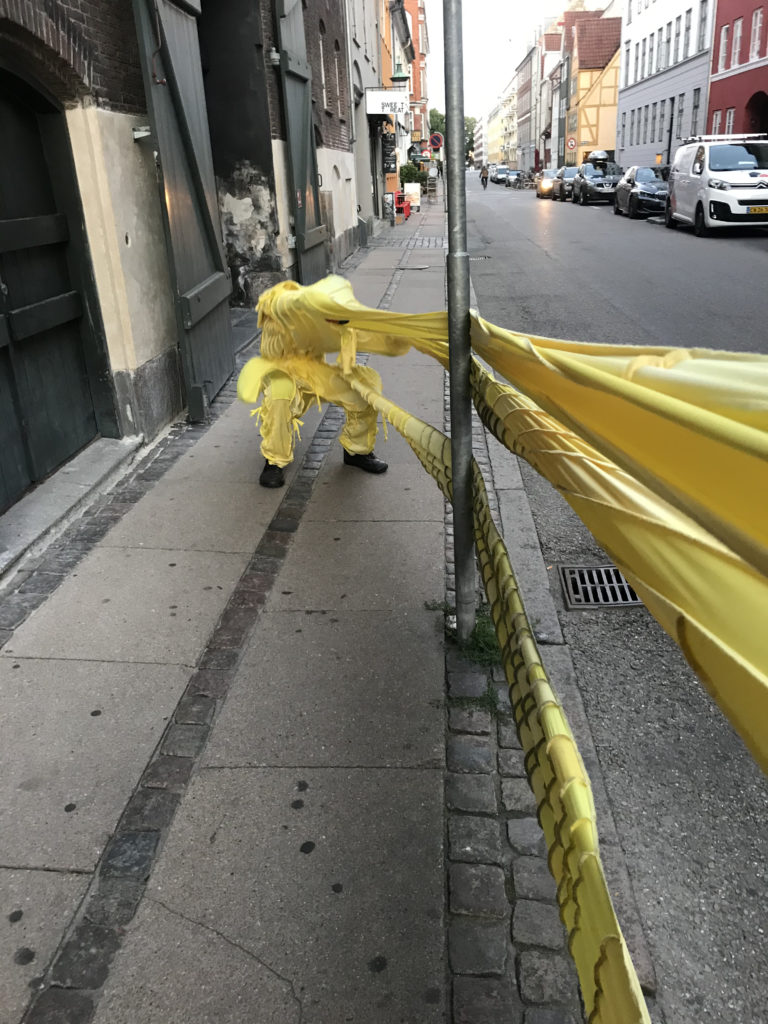
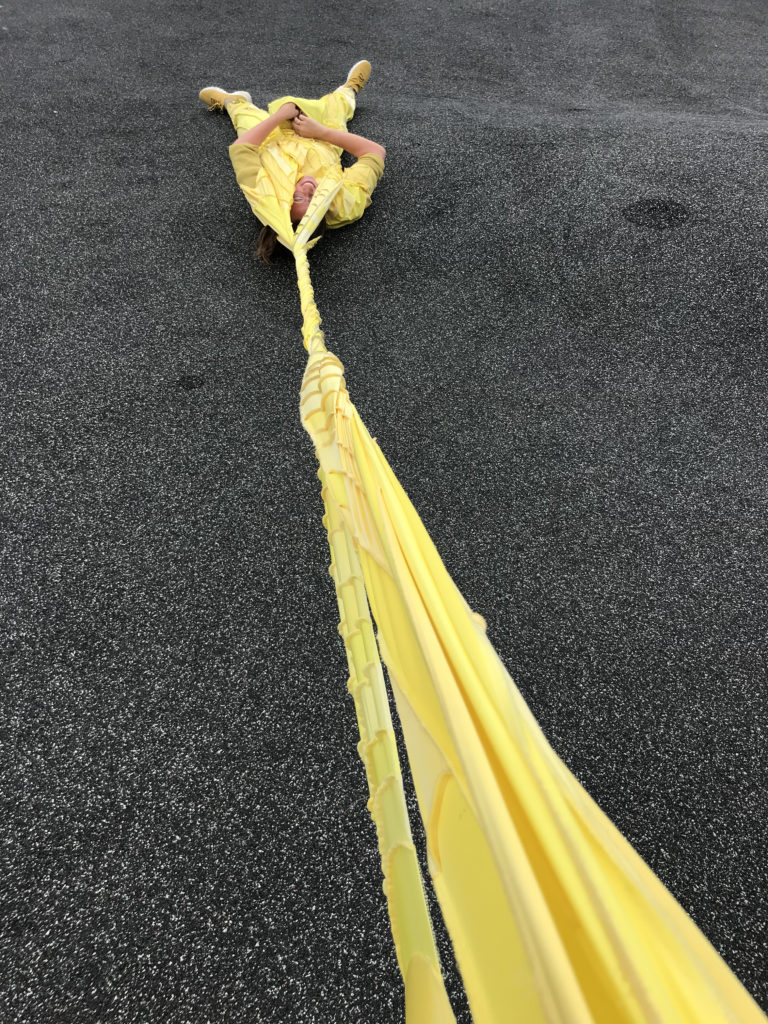
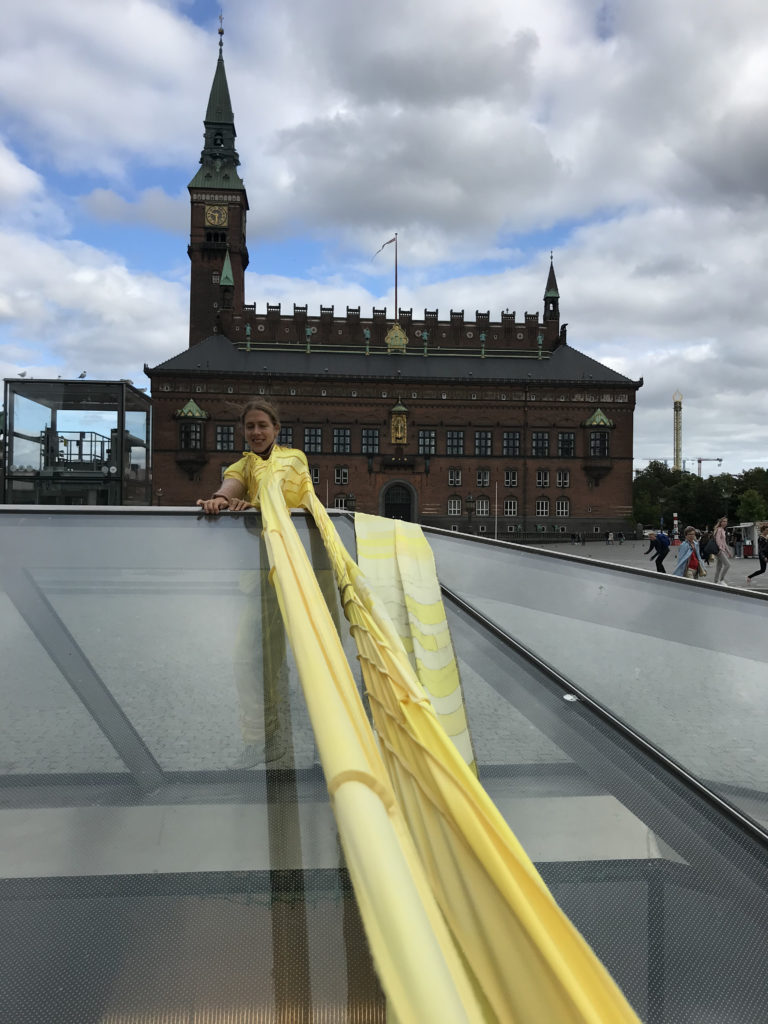
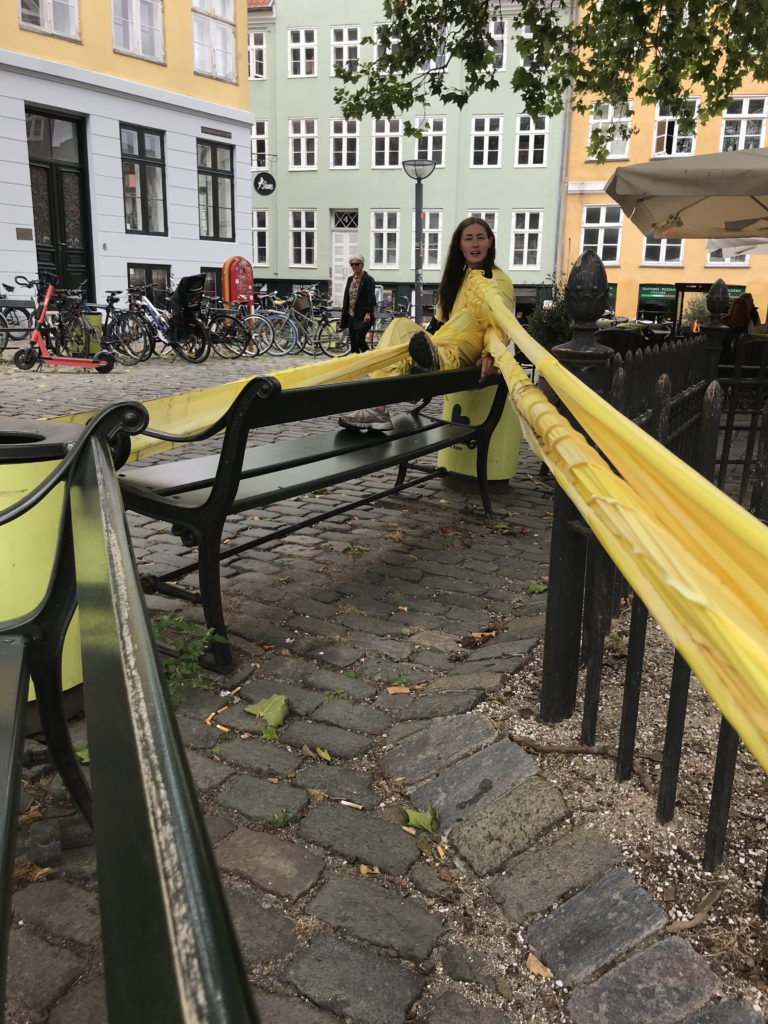
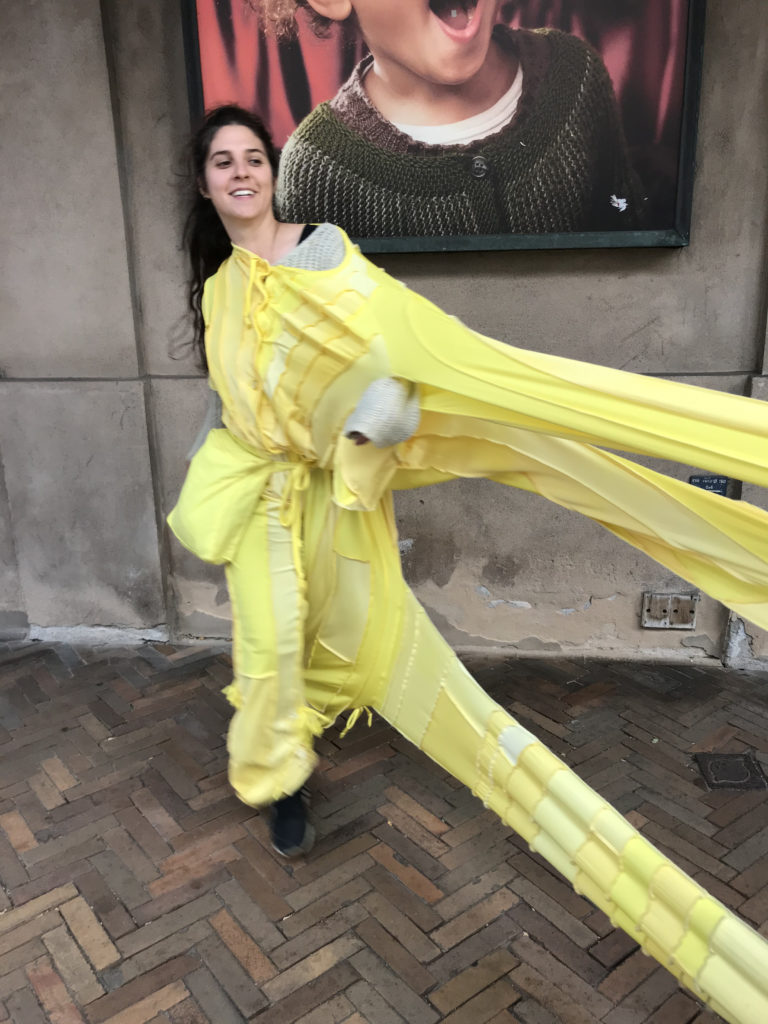
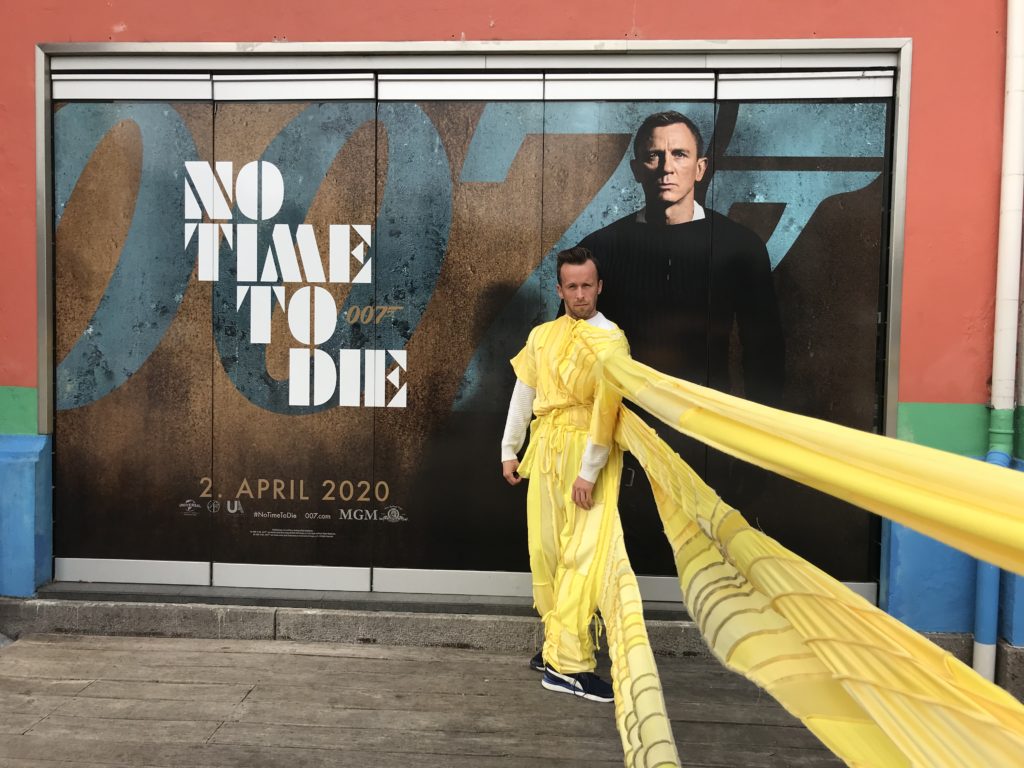
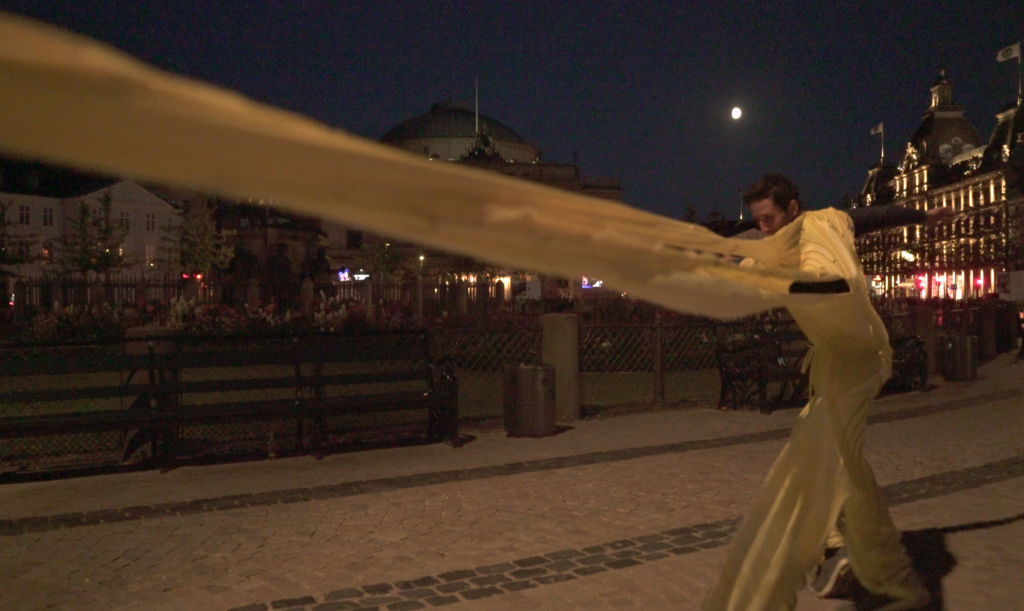
Video abstract: This Critical Costume exhibition presentation derives from the twelve-hour costume-based ‘performative-walk’ Community Walk (2020). The frame for Community Walk was a bright yellow costume that physically connected two wearers. In Community Walk I, the researcher and costume designer, placed myself ‘in the centre’ of the co-wearing entanglements. For twelve hours I co-wore the costume in the central area of Copenhagen, DK connected to twelve different co-wearers. One hour with each co-wearing participant. In the video I share some of the values that are the foundation for my artistic practice and research – hence, for this project. I unfold aspects of the co-wearing experience. For example, that the costume orientated the co-wearers towards each other and that they as a connected pair had to navigate and negotiate the costume, by-passing spectator(s), and urban environment. 


The video

AweAre – an embodied explorative workshop

At the PARSE conference I introduced the concept of co-costuming by inviting the participant to wear, explore and reflect on the bodily effects of costumes that connects two wearers. As researcher, I asked the participants to confront the ethically dimensions of the co-costumed experience (costumes that I produced and impose on wearers) that potentially was quite playful and, at the same time, bodily and socially restricted and/or exposeed the co-wearers.


Community Walk

July 30th I was invited to participate in Wa(l)king Copenhagen created and organized by Metropolis.

My contribution Community Walk became an wonderful experience of 12 hours of physical and verbal conversation about community (fællesskab), 12 hours of following and leading, 12 hours of being connected, 12 hours of being approached, ignored, commented on, yelled at and 12 hours of moving in and reacting on the city and the environment

Every hour we livestreamed on Wa(l)king Copenhagen’s facebook.

Camille Marchadour and myself

In the program (danish) I wrote the following:

I en tid hvor vi opfordres til at holde distance er Community Walk en undersøgelse af, hvordan vi skaber fysisk nærvær. Hvordan mødes vi, når vante ritualer som håndtryk og knus frarådes? Hvordan anerkender vi hinandens nærvær, når vi individuelt og kollektivt udføre social kontrol i angsten for en invaderende skjult fjende? 

Over 12 timer undersøger jeg sammen med 12 gæster nærheden og distancen i fælleskaber, hvor 5 handliger og en klædning er vores fælles omdrejningpunkt. Hver time møder jeg en ny gæst i det centrale København, hvorfra vi forbundne vil vandre mod næste gæst. Hver gæsten inviteres til at fortolke de 5 handlinger. 

En gul klædning forbinder mig og vandringsgæsten. Gennem klædning undersøger vi, hvordan vi kan mærke vi hinandens nærvær. Samtidig navigerer og forhandler vi i fællesskab, hvordan vi kan holde distance til hinanden og til andre. Foranlediget af steder og mennesker, vi passerer i byens rum, reflekterer vi fysisk og verbalt over begrebet fælleskab. Hvordan har fælleskabet det – har vores fælleskaber forandret sig?

Julienne Doko and myself

5 Community Walk handlinger:

Handling 1 – Velkomst-ritual; Hilsen i nærheden men på distance 

Handling 2 – Afklædnings- og Iklædnings-ritual; Overdrager klædningen til den nyankomne 

Handling 3 – Afskeds-ritual; Afsked med forrige gæst

Handling 4 – Vidnesbyrd-ritual; Som et vidensbyrd på samtalen og/eller af den fysiske oplevelse vandringen har afstedkomme, reflekterer den afskedstagende gæst over begrebet fællesskab.

Handling 5 – Vandrings-ritual; Forhandling og navigation gennem byen 

Community Walk foregår d. 30 juli kl 11-23 i det centrale København. Ruten repræsenterer steder jeg under lockdown mødte/gik tur med andre, hvor jeg savnede nærværet af andre og steder hvor byens rum pludselig var affolket. Publikum er velkomme til at møde og følge os på afstand.

kl 11 Sølvtorvet; danser/koreograf Daniel Jeremiah Persson

kl 12 Østerport Station; danser Camille Marchadour

kl 13 Amaliehaven; designer/fotograf Agnes Saaby Thomsen

kl 14 Israels Plads; Fru Elsa Kragh Madsen 

kl 15 Nørreport Station; danser/koreograf Tanya Rydell Montan

kl 16 Gråbrødre Torv; danser/koreograf Julienne Doko

kl 17 Nikolaj Plads; dansekunstner Anna Stamp

kl 18 Rådhus Pladsen; danser/koreograf Paul James Rooney

kl 19 Hovedbanegården; scenograf Aleksandra Lewon

kl 20 Christiansborg; danser Josefine Ibsen

kl 21 Vor Frelser Kirke; kostumedesigner Jeppe Worning

kl 22 Kongens Nytorv, visual artist/danser Benjamin Skop

kl 23 Sølvtorvet; endestation